Introduction
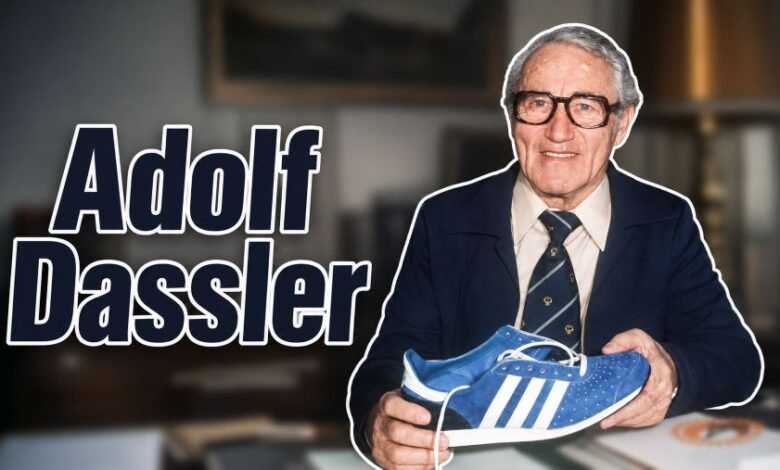
Adolf “Adi” Dassler was a German shoemaker, sports-footwear designer and entrepreneur whose practical ideas changed the relationship between athletes and their equipment. He founded Adidas, one of the world’s best-known sportswear companies, after beginning with a small workshop inside his mother’s laundry building.
Dassler believed that athletes should not depend on one general-purpose shoe. Instead, footwear should be designed around the sport, playing surface and movement of the person wearing it. That simple idea guided his career and helped shape the modern sporting-goods industry.
Adolf Dassler Quick Facts
| Detail | Information |
|---|---|
| Full name | Adolf Dassler |
| Common name | Adi Dassler |
| Date of birth | 3 November 1900 |
| Birthplace | Herzogenaurach, Bavaria, German Empire |
| Nationality | German |
| Profession | Shoemaker, designer, inventor and entrepreneur |
| Known for | Founding Adidas |
| Spouse | Käthe Dassler |
| Children | Horst, Inge, Karin, Brigitte and Sigrid |
| Date of death | 6 September 1978 |
| Age at death | 77 |
| Burial place | Family grave in Herzogenaurach |
Early Life in Herzogenaurach
Adolf Dassler was born on 3 November 1900 in Herzogenaurach, a Bavarian town with a strong connection to footwear manufacturing. He was the youngest of four children born to Christoph and Pauline Dassler.
His older siblings were Fritz, Marie and Rudolf. Christoph had connections with the local shoe trade, while Pauline operated a laundry service from the family home.
As a child, Adi helped his mother collect and deliver laundry. Sport was also an important part of his youth. He participated in football, athletics, boxing, ice hockey, javelin, skiing and ski jumping with his childhood friend Fritz Zehlein.
These activities gave him direct experience of the different movements required by individual sports. He began to understand that runners, footballers and other athletes needed footwear made for their particular physical demands.
Dassler completed school in 1913. At his father’s request, he trained as a baker and completed the apprenticeship, although he did not wish to spend his working life in that profession.
He later developed practical shoemaking skills while working with experienced craftsman Karl Zech. During 1932 and 1933, he attended a specialist footwear school in Pirmasens, where he studied shoe construction and manufacturing techniques.
Military Service and the First Workshop
In June 1918, shortly before his eighteenth birthday, Dassler entered military service during the closing months of the First World War. He remained in service until October 1919 before returning home.
After the war, Germany faced shortages of materials, machinery and electricity. Dassler responded by converting part of his mother’s laundry building into a small workshop.
In 1920, he and Karl Zech began producing sports shoes and sandals. Dassler also repaired ordinary footwear to earn money while developing his early products.
Available resources were limited, so he reused military materials and adapted existing equipment. A leather-processing machine was reportedly connected to a stationary bicycle, with his first employee, Josef Erhardt, providing the pedal power.
This unusual system is one of the lesser-known details of Dassler’s early career. It also shows the practical problem-solving approach that remained central to his later innovation.
Partnership With Rudolf Dassler
Adi invited his brother Rudolf to join the operation in 1923. On 1 July 1924, they formally registered the Gebrüder Dassler Schuhfabrik, commonly translated as the Dassler Brothers Shoe Factory.
The brothers brought different abilities to the company. Adi concentrated on product design, testing and manufacturing, while Rudolf focused on sales and promotion.
Adi was generally described as quiet and technically minded. Rudolf was more outgoing and commercially focused. Their contrasting personalities initially helped the business because each brother handled a different part of its development.
By 1925, they were producing football boots fitted with leather studs and running shoes with hand-forged spikes. As demand increased, the company moved from the laundry building to a larger factory near Herzogenaurach railway station.
Olympic Recognition
Dassler understood that major sporting events could prove the quality of his footwear. Athletes competing at the highest level offered both practical feedback and international visibility.
At the 1928 Amsterdam Olympics, German runner Lina Radke wore Dassler shoes while winning the women’s 800 metres and setting a world record.
The company’s footwear appeared again at the 1932 Los Angeles Olympics. German sprinter Arthur Jonath won a bronze medal in the men’s 100 metres while wearing Dassler shoes.
The most famous Olympic connection came at the 1936 Berlin Games. Dassler supplied track shoes to American athlete Jesse Owens, who won four gold medals.
Historical accounts often state that Owens wore Dassler shoes during all four victories. However, surviving evidence does not conclusively establish which shoes he used in every event. What is supported is that Dassler supplied him with footwear and that the two remained in contact.
Marriage and Family
Adolf Dassler met Käthe Martz while studying footwear production in Pirmasens in 1932. Her father, Franz Martz, was a master last-maker connected with the specialist school.
Adi and Käthe married on 17 March 1934. She then moved to Herzogenaurach and became closely involved in the family company.
They had five children: Horst, Inge, Karin, Brigitte and Sigrid. Each later contributed to the business in a different role.
Horst managed the French operation and supported international expansion. Inge worked with sporting contacts in Germany, Karin handled publicity and advertising, Brigitte dealt with international customers, and Sigrid managed textile-related activities.
Käthe worked in sales, exports, distribution relationships and company administration. Her contribution became especially important after Adolf’s death, when she assumed control of Adidas.
Nazi Party Membership and Wartime Production
Adolf and Rudolf Dassler joined the Nazi Party on 1 May 1933 and remained members until the regime collapsed in 1945. Historical accounts mention business and economic pressure, but the available evidence does not establish Adolf Dassler’s personal political beliefs with certainty.
He was called into military service again during the Second World War. From 1940 into 1941, he trained and served as a radio operator.
Dassler was later released because the authorities considered his factory role important to production. As the war continued, sporting-shoe manufacturing became increasingly restricted.
By late 1943, workers and machinery at the Dassler factory were being used to produce components for anti-tank weapons under wartime contracts.
After Germany’s defeat, Dassler faced denazification proceedings. He was temporarily prevented from managing the factory without restriction.
He was initially classified as a lesser offender before being reclassified as a follower. In February 1947, he received permission to resume full control of the business.
The Split That Created Adidas and Puma
The relationship between Adi and Rudolf worsened during and after the war. Their disagreements involved family tensions, different management styles and accusations connected with their denazification cases.
In 1948, they divided the company. Adi retained the factory near the railway station, while Rudolf established the business that later became Puma.
Around two-thirds of the original workforce reportedly remained with Adi. Many of those employees worked in product development and manufacturing.
The brothers never reconciled. Their rivalry also divided parts of Herzogenaurach, with residents, employees and local businesses becoming associated with one company or the other.
The conflict became one of the most famous family disputes in commercial history. It also created two sporting brands that would compete internationally for decades.
How Adolf Dassler Founded Adidas
Dassler initially considered calling his new company “Addas”, combining parts of his nickname and surname. A similar name had already been registered, so he added an “i”.
The name Adidas therefore comes from “Adi” and the opening part of “Dassler”. It was not originally an abbreviation of the phrase “All Day I Dream About Sports”.
On 18 August 1949, Dassler registered Adolf Dassler adidas Sportschuhfabrik in Herzogenaurach. The company began its independent life with 47 employees.
The three-stripe footwear design was also registered. Although the stripes became a famous visual identity, they originally had a practical purpose by helping to support and stabilise the shoe.
The 1954 World Cup Breakthrough
Dassler worked closely with West Germany’s national football team and coach Sepp Herberger. He supplied lightweight boots that could be fitted with studs of different lengths.
The 1954 World Cup final between West Germany and Hungary was played in wet conditions. Longer studs were fitted to the German players’ boots to improve their grip.
West Germany won the match 3–2 in a result remembered as the Miracle of Bern. The victory brought worldwide attention to Adidas and showed how technical equipment could affect performance in difficult conditions.
Dassler is sometimes called the sole inventor of screw-in football studs. That description is inaccurate because patents for replaceable studs existed before Adidas used the system.
His contribution was the successful refinement, manufacture and elite-level application of interchangeable studs. The 1954 final turned that practical development into an internationally recognised product story.
Product Development and Business Growth
Dassler continued developing specialised equipment for football, athletics, boxing, tennis, ice hockey and other sports.
The original Samba was introduced in 1950 for football on icy or snowy surfaces. Adidas produced its first sports bag and athletics footwear with replaceable steel spikes in 1952.
Further developments included lightweight nylon soles, the Adilette sandal and the company’s move into sports clothing. The Franz Beckenbauer tracksuit became its first major apparel product in 1967.
The Adidas Telstar was used as the official ball of the 1970 World Cup. The Trefoil logo followed in 1972 and became another lasting part of the company’s identity.
By 1960, Adidas employed approximately 550 people and was described as the world’s largest sports-shoe producer. Its rapid business growth came from combining technical development, athlete feedback and visibility at major competitions.
Leadership and Working Philosophy
Dassler preferred workshops and product testing to personal publicity. He rarely gave interviews and generally avoided becoming the public face of the company.
Employees called him “Chef”, the German word for boss. He was described as quiet, exacting, creative and strongly focused on practical results.
He kept notebooks around his home so that he could record ideas whenever they appeared. His working method involved observing athletes, studying how their feet moved and asking them about weaknesses in existing products.
That approach placed product development at the centre of his leadership. Rather than beginning with advertising, he began with a sporting problem and tried to design a useful solution.
His best-documented motto was: “Only the best for the athlete.”
Awards and Honours
Dassler received the Federal Republic of Germany’s Order of Merit, First Class, in 1968.
In 1974, he received the Bavarian Order of Merit. Four years later, he became the first non-American admitted to the National Sporting Goods Industry Hall of Fame.
These honours recognised both his commercial success and his contribution to the development of modern sporting equipment.
Death and Company Succession
Adolf Dassler died in Herzogenaurach on 6 September 1978. He was 77 and had experienced a brief illness before his death.
He was buried in the family grave at the church cemetery in Herzogenaurach. His principal dates, family history and company role are documented by the Adi and Käthe Dassler Memorial Foundation.
Käthe Dassler took control of Adidas after his death. Their son Horst later became the company’s principal business leader and continued its international expansion.
Käthe died in 1984, while Horst died in 1987. Their deaths brought the period of direct Dassler family leadership closer to its end.
Adolf Dassler’s Lasting Impact
Dassler helped establish the idea that athletic equipment should be developed for the demands of each sport. His work brought together careful observation, athlete feedback, product testing and competition performance.
He also recognised the importance of major sporting events long before modern sponsorship became a central part of the industry. Olympic appearances and World Cup success allowed athletes to test his products while introducing the brand to an international audience.
His record is not without difficult chapters. His Nazi Party membership, wartime factory activity and denazification proceedings remain documented parts of his history and should be considered alongside his commercial achievements.
In 2006, a life-size bronze statue of Dassler was installed at the Adi Dassler Stadium in Herzogenaurach. The statue shows him seated with a sports shoe, reflecting the practical design work that defined his career.
From a workshop powered partly by a bicycle to a company recognised around the world, Adolf Dassler built his success around one consistent belief: sporting products should serve the athlete first.
Conclusion
Adolf Dassler did more than create a famous brand name. He studied athletes, developed prototypes, tested materials and adjusted footwear for real competition conditions.
His journey included family partnership, Olympic recognition, wartime controversy, a bitter split with his brother and the creation of Adidas. Through specialised footwear and athlete-centred design, he helped establish many of the methods now used throughout the global sportswear industry.
Adolf Dassler transformed practical shoemaking into a worldwide sporting legacy built around performance, testing and athlete needs.