Hannah Critchlow: The Brilliant British Neuroscientist Transforming Minds and Challenging Fate
A Deep Dive into the Life, Career, and Impact of an Inspiring Science Communicator

Introduction
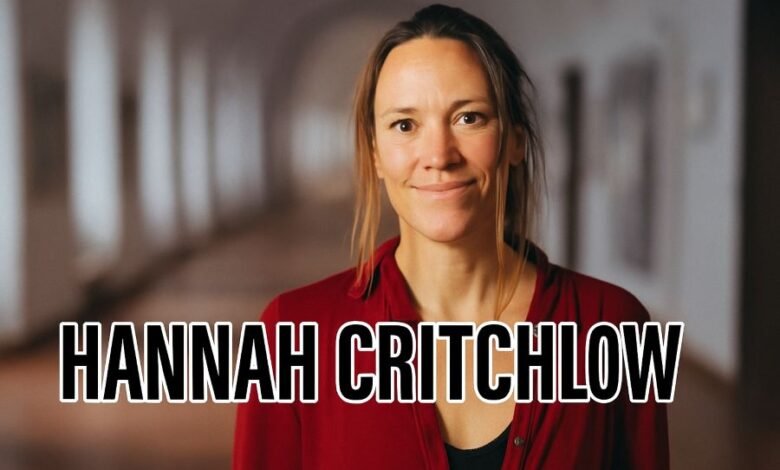
Hannah Critchlow is a celebrated British neuroscientist, author, and science communicator whose work bridges the gap between cutting-edge brain research and the everyday understanding of human behavior. Known for her engaging style and deep scientific insight, she has become one of the most influential voices in modern neuroscience. Her passion for explaining how the brain works — and how our thoughts, decisions, and connections shape our world — has inspired millions worldwide.
Throughout her remarkable career, Hannah Critchlow has not only explored the mysteries of the brain but also challenged traditional ideas about free will, intelligence, and collective thinking. She believes that understanding the human mind is key to solving global challenges and improving our lives. Her positive outlook, scientific clarity, and engaging communication style have made her a trusted voice in science media and education.
Table of Contents
ToggleQuick Bio
| Attribute | Detail |
|---|---|
| Full Name | Hannah Marion Critchlow |
| Born | 1980 |
| Birthplace | Leicester, England, United Kingdom |
| Nationality | British |
| Profession | Neuroscientist, Author, Broadcaster, Science Communicator |
| Education | BSc in Cell & Molecular Biology (Brunel University); PhD in Neuroscience (University of Cambridge) |
| Institutional Affiliation | Magdalene College, University of Cambridge |
| Notable Works | Consciousness, The Science of Fate, Joined-Up Thinking |
| Children | 1 |
| Recognition | Top 100 UK Scientists (Science Council, 2014); Honorary Doctorate, Brunel University (2022) |
Early Life and Education
Born in Leicester, England, Hannah Critchlow developed an early curiosity about the human brain. Her interest in neuroscience emerged during her teenage years when she worked at a psychiatric hospital and saw firsthand the complexity of mental health and human behavior. This experience became a turning point, guiding her toward a lifelong passion for understanding how the mind functions.
She pursued a degree in Cell and Molecular Biology at Brunel University, where she graduated with First-Class Honours and received multiple academic prizes. Later, she joined the University of Cambridge, earning her PhD in Neuroscience. Her doctoral research focused on the plasticity of dendritic spines — structures vital for learning and memory — and how changes in these neural connections relate to mental health disorders like schizophrenia.
Academic Career and Research Contributions
As a British neuroscientist, Hannah Critchlow’s academic journey is marked by rigorous research and innovation. After completing her PhD, she held fellowships at Cambridge and Oxford, contributing to groundbreaking work in cellular neuroscience. Her studies on neural connectivity and brain adaptability have helped clarify how our experiences shape the mind.
Critchlow’s work also extends beyond laboratory research. She has emphasized the social and ethical implications of neuroscience, particularly how brain science can inform education, leadership, and decision-making. Her ability to make complex ideas understandable to non-scientists has become her defining strength.
Science Communication and Media Presence
Hannah Critchlow is widely recognized for her outstanding ability to communicate science to the public. She began her communication career with The Naked Scientists, a popular science radio show and podcast. Her engaging storytelling and accessible explanations quickly gained her a following among both academics and the general public.
She has appeared on BBC television and radio programs, including Tomorrow’s World Live and BBC Family Brain Games, bringing neuroscience into homes across the UK. Her efforts have earned her a place among the country’s most influential science communicators. Through these platforms, she has not only educated audiences but also encouraged more young people — especially women — to pursue science.
Books and Written Works
Hannah Critchlow’s books have been praised for their clarity, insight, and thought-provoking ideas. Her first major publication, Consciousness: A Ladybird Expert Guide (2018), explains the science of awareness and perception in a concise, engaging way. It was followed by The Science of Fate (2019), which explored how genetics, brain wiring, and environment influence our choices — challenging the traditional idea of absolute free will.
In 2022, she published Joined-Up Thinking: The Power of Collective Intelligence to Change Our Lives, focusing on how collaboration and shared knowledge can create smarter, more connected societies. Each of her books reflects her mission: to make neuroscience practical and relevant for everyday life.
Awards and Recognition
Hannah Critchlow’s influence as a British neuroscientist and communicator has earned her several major honors. In 2014, the Science Council named her among the UK’s Top 100 Practising Scientists for her contribution to science communication. In 2019, Nature magazine recognized her as one of Cambridge University’s “Rising Stars in Life Sciences.”
In 2022, Brunel University — where she began her academic journey — awarded her an Honorary Doctorate for her work in advancing neuroscience and inspiring public engagement. These accolades affirm her dual legacy as both a serious researcher and a passionate educator.
Philosophy and Vision
At the core of Hannah Critchlow’s philosophy is the belief that understanding the brain helps us understand ourselves. She emphasizes that our actions, emotions, and relationships are influenced by both biology and environment. However, she also argues that knowledge empowers us to make better decisions — both individually and collectively.
Her recent focus on collective intelligence explores how groups, communities, and societies can think more effectively together. She believes that collaboration, empathy, and shared understanding can lead to breakthroughs not just in science, but in global progress. This vision aligns with her positive message: while our brains may shape our fate, awareness gives us the power to shape the future.
Legacy and Impact
Hannah Critchlow’s legacy lies in her ability to transform neuroscience from a complex academic field into an inspiring tool for everyday life. Her work demonstrates that science is not only about discovery but also about connection — between neurons, ideas, and people.
As one of the most influential British neuroscientists of her generation, she continues to inspire curiosity, creativity, and collaboration. Her books and talks encourage audiences to see their minds not as fixed, but as adaptable and capable of extraordinary change. In a world increasingly shaped by technology and uncertainty, her message of understanding and empowerment feels more relevant than ever.
Conclusion
Hannah Critchlow stands as a symbol of modern scientific communication — passionate, knowledgeable, and deeply human. Her career blends rigorous research with storytelling that touches the heart and mind. She shows that science can be both powerful and compassionate, factual yet inspiring.
Her journey from Leicester to Cambridge, from research to broadcasting, embodies what it means to bring science into the real world. Whether she’s explaining the mysteries of consciousness or the science of collective intelligence, Hannah Critchlow reminds us that knowledge is our greatest tool for change — and understanding the brain may be the key to understanding ourselves.
FAQ
Q1: Who is Hannah Critchlow?
Hannah Critchlow is a British neuroscientist, author, and science communicator known for her work in neuroscience and public education.
Q2: What is she best known for?
She is known for her bestselling books, science communication on BBC platforms, and her research on brain plasticity and decision-making.
Q3: Where does she work?
She is affiliated with Magdalene College, University of Cambridge.
Q4: What are Hannah Critchlow’s most popular books?
Her major works include Consciousness, The Science of Fate, and Joined-Up Thinking.
Q5: Why is she important in modern science?
Hannah Critchlow plays a vital role in making neuroscience accessible, inspiring young scientists, and promoting public understanding of how the brain shapes human experience.
Q6: What topics does she focus on now?
Her current focus is on collective intelligence — how groups can think, collaborate, and innovate more effectively through shared understanding.
Q7: What is her lasting impact?
Her work encourages people to embrace both science and self-awareness, proving that knowledge of the brain can empower positive change in society.