Custom marble fabrication has become an important part of modern villa and boutique hotel design. In these projects, marble is not used only as a decorative surface. It is shaped, cut, polished, labeled, packed, and installed as a project-specific architectural material. A villa may need a marble staircase, bathroom vanity tops, fireplace surrounds, kitchen island panels, wall cladding, and outdoor transition pieces. A boutique hotel may require reception counters, lobby walls, guest bathroom vanities, bar tops, elevator surrounds, and repeated custom stone details.
Unlike standard tile supply, custom marble fabrication requires a closer connection between design intent and production accuracy. The buyer is not simply choosing a marble name or slab color. The project team must confirm drawings, measurements, thickness, surface finish, edge profiles, cutouts, vein direction, joint positions, packing labels, and installation sequence. These details determine whether the final project looks refined or difficult to install.
For overseas buyers, developers, contractors, and interior designers, working with a supplier experienced in custom marble fabrication can help connect slab selection, cut-to-size production, edge finishing, inspection, packing, and export support into one organized project workflow.
Why Custom Marble Fabrication Matters in Modern Projects
Modern villas and boutique hotels often use cleaner lines, larger surfaces, hidden lighting, open spaces, and more precise material transitions than traditional interiors. This means marble pieces need to be produced with higher dimensional accuracy. A small mistake in a countertop cutout, wall panel size, staircase tread, or feature wall joint can affect the final appearance.
Custom fabrication is especially important when marble must connect with:
- Wood cabinetry
- Metal trims
- Glass partitions
- Bathroom fixtures
- Lighting channels
- Wall niches
- Fireplace openings
- Stair structures
- Built-in furniture
- Reception desks
- Vanity cabinets
In modern interiors, transitions are highly visible. A marble wall meeting a wood panel, a vanity top meeting a basin, or a staircase tread meeting a glass balustrade needs to be planned before production. Good fabrication helps the stone fit the design, not just the drawing.
For larger or multi-area projects, buyers may also review a stone project supplier in China when comparing project coordination, fabrication support, application experience, and export-oriented stone supply for villas, hotels, resorts, and commercial interiors.
Custom Marble Fabrication Is Not the Same as Slab Buying
Many buyers begin a project by choosing a beautiful marble slab. This is only the first step. Slab buying means purchasing raw or semi-finished material. Custom fabrication means turning that material into accurate, install-ready components.
Slab Buying Usually Focuses On:
- Stone type
- Color
- Veining
- Slab size
- Thickness
- Surface finish
- Price per square meter or slab
Custom Fabrication Also Includes:
- Cut-to-size drawings
- Edge profiles
- Sink and faucet cutouts
- Drainage openings
- Wall panel sequencing
- Stair dimensions
- Fireplace opening details
- Countertop joints
- Dry layout review
- Piece labels
- Export packing
For modern villas and boutique hotels, custom fabrication is often the better approach when the project has confirmed drawings and needs consistent, precise, and organized delivery.
Where Custom Marble Is Used in Modern Villas
Modern villas often combine luxury with comfort. Marble is used to create focal points, but it is also integrated into functional areas. The goal is not to cover every surface with stone, but to use marble where it adds value.
Entrance Areas
A villa entrance sets the tone for the entire home. Custom marble may be used for floor panels, console wall backgrounds, door surrounds, or elevator areas. Cut-to-size production helps align stone pieces with doorways, lighting strips, and wall panels.
Important details include:
- Floor pattern
- Wall panel height
- Doorway alignment
- Threshold pieces
- Skirting details
- Surface finish
- Joint layout
Living Room Feature Walls
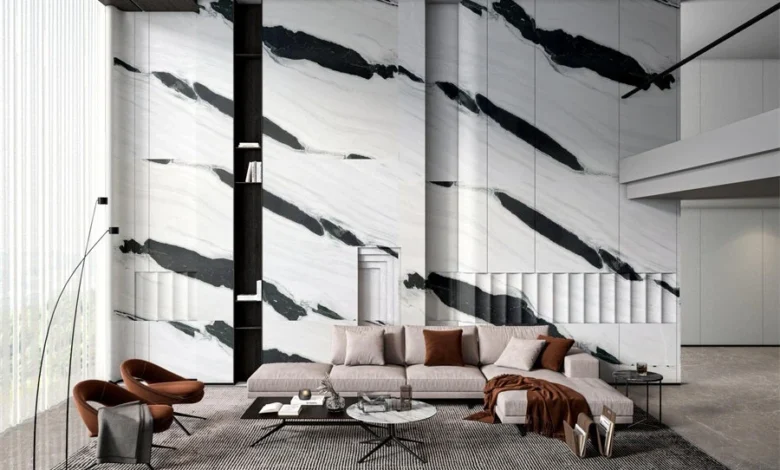
Modern villas often use marble feature walls behind fireplaces, media walls, or seating areas. These walls may use bookmatched marble, large slabs, or calmer stone panels depending on the design style.
Fabrication details may include:
- Panel size
- Vein direction
- Center line
- Socket cutouts
- Fireplace opening
- Edge finishing
- Panel numbering
A marble feature wall should be planned as a visual composition, not just a group of panels.
Kitchen Islands and Countertops
Kitchen islands are often one of the most visible marble applications in a modern villa. They may include waterfall sides, mitered edges, sink cutouts, cooktop openings, and integrated seating areas.
Buyers should confirm:
- Slab size
- Joint location
- Edge profile
- Mitered corner details
- Sink and faucet positions
- Appliance cutouts
- Support structure
- Surface finish
A kitchen island may look simple, but it requires highly accurate fabrication.
Bathrooms and Spa Areas
Luxury villa bathrooms often use custom marble for vanity tops, shower wall panels, bathtub surrounds, niches, thresholds, and bench tops. These areas require both beauty and water-area planning.
Bathroom fabrication should confirm:
- Wet or dry wall areas
- Vanity top cutouts
- Faucet hole positions
- Shower panel dimensions
- Bathtub surround layout
- Niche sizes
- Threshold and curb pieces
- Room labels
Small bathroom pieces are easy to overlook, but they are essential for a smooth installation.
Staircases
A marble staircase can become one of the most architectural features in a villa. Treads, risers, landings, side panels, and skirting pieces must be produced accurately.
Key details include:
- Tread depth
- Riser height
- Landing size
- Edge profile
- Anti-slip consideration
- Finish type
- Piece sequence
- Packing labels
Staircases leave little room for error. One wrong piece can affect the entire installation.
Where Custom Marble Is Used in Boutique Hotels
Boutique hotels usually focus on character, atmosphere, and memorable guest experience. Unlike large chain hotels, boutique hotels often use stone to create a more distinctive identity. Custom fabrication helps create unique design details while still supporting practical hotel operations.
Reception Counters
The reception counter is often the first close-contact stone feature guests see. Marble may be used for the counter front, countertop, side panels, or backdrop wall.
Important fabrication points include:
- Counter height
- Front panel size
- Countertop thickness
- Edge design
- Lighting integration
- Cable or service openings
- Joint positions
- Surface protection
A well-fabricated marble reception counter can make the hotel feel more premium from the first moment.
Lobby Feature Walls
Boutique hotels often use dramatic marble in small but memorable ways. A bookmatched lobby wall, elevator background, or seating-area feature panel can help define the brand mood.
For lobby walls, buyers should check:
- Slab pattern
- Viewing distance
- Wall size
- Lighting direction
- Panel sequence
- Joint placement
- Dry layout photos
- Installation labels
Guest Bathroom Vanities
Hotel bathroom vanity tops are repeated many times, so consistency is important. Even a small fabrication issue can become a major problem if repeated across many rooms.
Vanity top details should include:
- Room type
- Top length and depth
- Sink cutout size
- Faucet hole position
- Edge profile
- Backsplash height
- Side splash requirement
- Piece labels by room
Bar Tops and Restaurant Counters
Boutique hotels often use marble in bars, cafés, restaurants, and lounges. These areas require more practical review because surfaces may face drinks, food, cleaning, and frequent use.
The project team should review:
- Stain risk
- Maintenance expectations
- Edge durability
- Counter height
- Joint location
- Lighting reflection
- Cleaning routine
Key Fabrication Details Buyers Should Confirm
Custom marble fabrication depends on detailed confirmation. Buyers should not rely on general descriptions such as “standard edge” or “normal cutout.” Every visible and functional detail should be clear.
1. Final Dimensions
Dimensions should come from approved drawings or final site measurements. For overseas production, measurement accuracy is critical because pieces may be difficult to modify after delivery.
2. Thickness
Common thickness choices depend on application, design, and installation method. Wall panels, vanity tops, countertops, stairs, and floor panels may require different thicknesses.
3. Surface Finish
The finish affects both appearance and use. Polished marble creates depth and reflection. Honed marble feels softer and more modern. Textured finishes may be considered for certain floor or outdoor areas.
4. Edge Profiles
Edge design changes the look of the stone. Common options may include straight edge, eased edge, beveled edge, bullnose, half bullnose, mitered edge, or custom profiles.
5. Cutouts
Cutouts must be accurate. These may include:
- Sink openings
- Faucet holes
- Cooktop openings
- Socket holes
- Drain openings
- Lighting channels
- Fixture openings
6. Vein Direction
Vein direction is important for feature walls, countertops, islands, and large panels. Buyers should confirm whether the veining should run vertically, horizontally, or follow a specific design axis.
7. Piece Labels
Every custom piece should be labeled clearly. This is especially important for hotels, multi-room villas, staircases, wall panels, and bathroom packages.
Design Differences Between Modern Villas and Boutique Hotels
Although both project types may use custom marble, their design priorities are not identical.
| Project Type | Main Priority | Marble Use | Key Risk |
| Modern Villa | Personal luxury and long-term comfort | Feature walls, bathrooms, stairs, kitchen islands | Overusing dramatic marble or missing custom details |
| Boutique Hotel | Brand identity and guest experience | Reception, lobby, bathrooms, bars, suites | Repetition errors, weak labeling, inconsistent materials |
| Resort Villa | Calm atmosphere and indoor-outdoor connection | Bathrooms, spa areas, pool houses, terraces | Wrong finish for wet or outdoor areas |
| Commercial Suite | Visual impact and durability | Counters, walls, elevator areas | Poor maintenance planning |
This comparison shows why custom fabrication should follow project type, not only stone type.
How Full Slab Approval Supports Better Fabrication
Small samples are useful, but they cannot show the full movement of natural marble. For custom fabrication, full slab approval is especially important because cutting decisions depend on the actual slab pattern.
Full slab approval helps buyers check:
- Color tone
- Vein movement
- Natural variation
- Usable slab area
- Matching potential
- Bookmatch possibility
- Defects or unwanted zones
- Cutting direction
For feature walls, kitchen islands, vanity tops, and reception counters, slab layout should be reviewed before cutting. This helps avoid placing important veins in awkward positions or wasting the most attractive part of the slab.
Dry Layout and Mock-Up Review
Dry layout means arranging cut pieces before packing to show how they will look together. It is useful for feature walls, floors, bookmatched panels, staircases, and repeated bathroom pieces.
A dry layout can help confirm:
- Panel sequence
- Vein matching
- Color consistency
- Joint position
- Overall visual balance
- Installation order
For boutique hotels, a mock-up bathroom or mock-up vanity area can also be useful before producing all repeated pieces. This allows the project team to confirm design and fabrication details early.
Quality Inspection Before Shipment
Inspection should happen before packing and loading. Since custom marble pieces are made for specific rooms or areas, replacement can be difficult if problems are discovered after arrival.
A useful inspection checklist includes:
- Material color
- Surface finish
- Thickness
- Dimensions
- Edge profile
- Cutout position
- Quantity
- Labels
- Dry layout when needed
- Packing condition
- Crate marks
- Loading photos
For overseas buyers, inspection photos provide important project records. They help confirm what was produced before the shipment leaves the factory.
Export Packing for Custom Marble Pieces
Custom marble pieces need strong and organized packing. Finished edges, corners, cutouts, and polished surfaces can be damaged if not protected properly.
Good export packing may include:
- Strong wooden crates
- Foam or soft separators
- Corner protection
- Surface protection
- Waterproof covering
- Internal supports
- Piece labels
- Crate marks
- Packing list
- Loading photos
For project orders, packing should follow installation logic. Pieces for the same room or area should be grouped when possible. Labels should match drawings and packing lists.
Common Mistakes in Custom Marble Fabrication Projects
Mistake 1: Starting Production Before Drawings Are Final
Custom pieces should not be produced from unfinished drawings. Changes after cutting can lead to waste, delays, and replacement cost.
Mistake 2: Choosing Marble Without Considering Application
A stone that looks beautiful on a feature wall may not be suitable for a high-use countertop or wet floor. Application should guide material selection.
Mistake 3: Ignoring Small Pieces
Thresholds, niches, side splashes, skirting, curbs, and trim pieces are often forgotten. These small items can delay installation.
Mistake 4: Not Confirming Edge Profiles
The edge profile affects both appearance and function. It should be shown clearly in drawings or reference images.
Mistake 5: Weak Labeling
Custom pieces can be difficult to identify if labels are unclear. This is a major problem for hotels and large villas.
Mistake 6: Poor Packing for Fragile Pieces
Vanity tops with sink cutouts, long stair pieces, and thin wall panels need careful protection during shipping.
Practical Checklist Before Ordering Custom Marble
Design Checklist
- Project type confirmed
- Application areas listed
- Design style defined
- Main marble features selected
- Lighting direction reviewed
- Related materials checked
Material Checklist
- Marble type selected
- Full slab photos approved
- Thickness confirmed
- Finish confirmed
- Vein direction reviewed
- Matching requirements checked
Fabrication Checklist
- Final drawings confirmed
- Dimensions checked
- Edge profiles approved
- Cutouts confirmed
- Wall panel layout reviewed
- Stair details confirmed
- Vanity top details checked
- Piece labels planned
Inspection and Packing Checklist
- Finished piece photos required
- Dry layout photos requested when needed
- Quantity checked
- Labels confirmed
- Packing method approved
- Crate marks reviewed
- Loading photos requested
FAQ
1. What is custom marble fabrication?
Custom marble fabrication is the process of cutting, shaping, polishing, edging, drilling, labeling, and packing marble according to project-specific drawings. It is used for countertops, vanity tops, staircases, wall panels, fireplaces, reception counters, and other custom interior or architectural stone pieces.
2. Why is custom marble fabrication important for villas?
Custom marble fabrication is important for villas because many villa stone areas require exact dimensions and special details. Bathrooms, staircases, feature walls, fireplace surrounds, kitchen islands, and vanity tops all need accurate cutting, edge processing, and layout planning to match the design.
3. What marble details are common in boutique hotels?
Boutique hotels commonly use custom marble for reception counters, lobby feature walls, guest bathroom vanity tops, shower panels, bar tops, restaurant counters, elevator surrounds, staircases, and decorative wall panels. These details help create a stronger brand atmosphere and guest experience.
4. What should buyers confirm before custom marble production?
Buyers should confirm final drawings, dimensions, thickness, surface finish, edge profiles, cutouts, vein direction, slab approval, piece labels, inspection requirements, and packing method before production begins. These details reduce errors and installation delays.
5. Is cut-to-size marble better than buying slabs?
Cut-to-size marble can be better when drawings and measurements are final and the buyer wants the supplier to handle fabrication before shipment. Buying slabs may be better if the buyer has strong local fabrication support or needs more flexibility on site.
Conclusion
Custom marble fabrication plays a major role in modern villas and boutique hotels because it turns natural stone into project-specific architectural components. A beautiful slab alone is not enough. The final result depends on how the marble is selected, cut, edged, drilled, labeled, inspected, packed, and installed.
For modern villas, custom marble can support feature walls, bathrooms, staircases, kitchen islands, fireplaces, and spa areas. For boutique hotels, it can define reception spaces, guest bathrooms, bars, lobbies, suites, and brand-focused interior details. In both cases, successful fabrication requires clear drawings, full slab approval, accurate dimensions, and organized packing.
When marble fabrication is handled carefully, the stone does more than decorate a space. It becomes part of the structure, identity, and long-term quality of the project.