Martha Rosler: The Visionary American Artist Who Redefined Art and Society
Exploring the Creative Journey, Influence, and Legacy of a Revolutionary Mind

Introduction
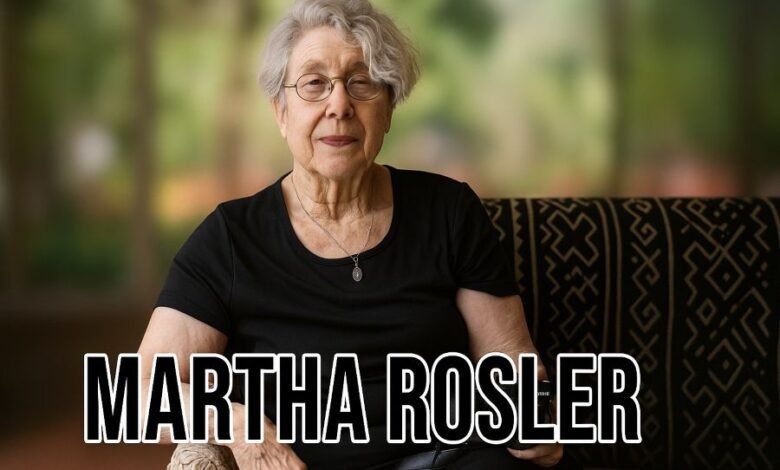
Martha Rosler is one of the most influential figures in contemporary art, renowned for blending creativity with social awareness. As an American artist, writer, and educator, she transformed traditional perceptions of art by addressing issues that connect personal experience with public reality. Born in Brooklyn, New York, in 1943, Rosler’s thought-provoking works continue to inspire conversations about politics, media, and gender. Her approach merges visual art with activism, making her an essential voice in both the feminist and conceptual art movements.
Rosler’s art challenges how people perceive everyday life. She often uses photography, video, performance, and installation to explore themes such as domestic life, war, and the influence of media. Unlike many artists who remain confined to galleries, Rosler brings art into public spaces and uses it to confront pressing social issues. Her career exemplifies how creativity can question systems of power while empowering audiences to see the world differently.
Table of Contents
ToggleQuick Bio
| Attribute | Details |
|---|---|
| Full Name | Martha Rosler |
| Date of Birth |
July 29, 1943
|
| Birthplace | Brooklyn, New York City, United States |
| Nationality | American |
| Profession | Artist, Writer, Educator |
| Education | B.A. from Brooklyn College (1965); M.F.A. from University of California, San Diego (1974) |
| Major Fields | Conceptual Art, Feminist Art, Socially Engaged Art |
| Known For | Video, Photography, Installation, Performance, Critical Writing |
Early Life and Education
Martha Rosler grew up in Brooklyn, New York, where her early exposure to urban life and cultural diversity deeply influenced her creative vision. Her experiences in a city filled with contrasts—between wealth and poverty, public and private life—later became a recurring theme in her art. She completed her undergraduate studies at Brooklyn College in 1965, where she began exploring ideas around social commentary and visual culture.
Afterward, she pursued a Master of Fine Arts at the University of California, San Diego, graduating in 1974. The environment of California in the late 1960s and early 1970s—defined by activism and experimentation—shaped her interest in combining politics and art. During this period, Rosler began to see art not only as expression but as a tool for change, a way to question media representation, gender roles, and systems of inequality.
The Beginning of a Revolutionary Career
Martha Rosler’s professional journey began in the 1970s, a pivotal time for feminist and conceptual art. She emerged as an American artist who pushed boundaries, rejecting the idea that art must remain detached from real life. Her early works directly critiqued the portrayal of women in media and the relationship between domesticity and power.
One of her most acclaimed early pieces, Semiotics of the Kitchen (1974–1975), used video performance to transform kitchen utensils into symbols of frustration and empowerment. This bold statement questioned society’s expectations of women, turning everyday objects into instruments of rebellion. Rosler’s innovative use of humor and critique established her as a leading feminist voice in the art world.
Artistic Style and Major Themes
Rosler’s art is known for its clarity, wit, and deep political insight. She merges photography, text, and video to highlight contradictions within culture and media. Her themes often revolve around domestic life, war, social inequality, and consumerism—subjects that expose the tension between comfort and conflict in modern society.
A recurring aspect of her work is the connection between private and public life. For example, in her famous photomontage series House Beautiful: Bringing the War Home, she combined glamorous magazine interiors with photographs of war zones. This striking contrast forces viewers to confront the hidden relationship between everyday comfort and global violence. Such works continue to resonate as commentaries on how media shapes perception.
Notable Works and Projects
Rosler’s artistic portfolio spans decades and includes several groundbreaking projects that influenced global art discourse. Her project The Bowery in Two Inadequate Descriptive Systems (1974–1975) examined language and representation by pairing photographs of New York’s Bowery district with descriptive texts about alcoholism. It revealed the limits of both photography and language in conveying social realities.
In 1989, she curated If You Lived Here…, a large-scale project addressing housing and homelessness in New York. Collaborating with artists, activists, and urban planners, Rosler turned art into civic dialogue. This project demonstrated how creativity can foster social change and remains a model for community-based art initiatives worldwide.
Teaching, Writing, and Influence
Beyond visual art, Martha Rosler is also a celebrated educator and writer. She taught for several decades, sharing her insights with students and shaping the next generation of socially conscious artists. Her essays and books—such as Decoys and Disruptions: Selected Essays 1975–2001—explore art’s role in society and the responsibilities of artists as cultural participants.
Her influence extends beyond classrooms and galleries. Many contemporary American artists cite Rosler as an inspiration for integrating activism with creativity. Her commitment to challenging systems of power and creating dialogue between art and community remains one of her greatest contributions to modern culture.
Recognition and Awards
Throughout her career, Rosler has received numerous honors for her contribution to art and society. Her works have been exhibited in major museums and international art events such as the Whitney Biennial, Documenta, and the Venice Biennale. She has also held retrospectives in leading institutions across Europe and the United States, affirming her global significance.
Her recognition is not only a result of her artistic excellence but also her courage to address difficult truths. Rosler’s ability to merge aesthetics with activism has inspired artists, scholars, and activists worldwide to use art as a catalyst for awareness and transformation.
Legacy and Lasting Impact
Martha Rosler’s legacy is one of empowerment, education, and social consciousness. She redefined what it means to be an American artist, proving that creativity can serve as both expression and activism. Her works continue to challenge audiences to question privilege, power, and perception.
By linking domestic imagery with political realities, Rosler transformed ordinary subjects into instruments of truth. Her art remains timeless because it encourages viewers to think critically about the world they inhabit. Today, her influence is seen not only in museums but also in public discourse, where the line between art and activism grows increasingly significant.
Conclusion
Martha Rosler stands as a trailblazer in contemporary art—a visionary who used her creativity to unveil hidden realities. Her pioneering efforts in feminist and socially engaged art have reshaped how society views art’s purpose. She proves that true artistry lies in the courage to question, to provoke, and to inspire transformation.
Through decades of innovative work, Rosler continues to remind us that art is not merely decoration but a form of resistance. Her voice, shaped by passion and intellect, remains essential to the ongoing conversation about justice, equality, and representation in art and life.
Frequently Asked Questions (FAQ)
Q1: Who is Martha Rosler?
Martha Rosler is an American artist, writer, and educator known for her socially engaged art and feminist themes.
Q2: What is Martha Rosler famous for?
She is best known for her video Semiotics of the Kitchen and her photomontage series House Beautiful: Bringing the War Home.
Q3: What type of art does she create?
Rosler works across video, photography, performance, and installation, often exploring social and political issues.
Q4: What makes Martha Rosler’s art unique?
Her art blends humor, critique, and realism, using everyday life to reveal complex social dynamics.
Q5: Why is Martha Rosler important in art history?
She is a pioneer of feminist and conceptual art whose influence continues to inspire artists to merge creativity with activism.