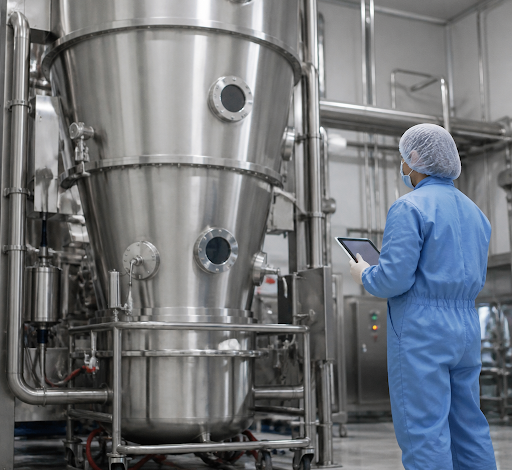
In today’s competitive manufacturing landscape, process engineers and plant managers are constantly seeking ways to optimize production efficiency without inflating capital expenditure. Drying technology sits at the heart of countless industrial operations — from pharmaceutical granulation to food processing and chemical manufacturing. Among the most reliable and energy-efficient drying solutions available, the fluid bed dryer has earned a well-deserved reputation for consistent performance, gentle product handling, and scalable throughput. As procurement strategies evolve, sourcing pre-owned process equipment has become a legitimate and increasingly popular route for businesses looking to expand capacity or replace aging machinery without the lead times and costs associated with new equipment orders.
Understanding Fluid Bed Drying Technology
Fluid bed dryers operate on a deceptively simple principle: a stream of heated air is forced upward through a perforated distributor plate, suspending particulate material in a fluidized state. This intimate contact between the drying medium and the product surface dramatically accelerates moisture removal compared to static or tray-based drying methods. The result is a highly uniform, efficiently dried product with minimal thermal degradation — a critical consideration in sectors such as pharmaceuticals, where active ingredient integrity must be preserved throughout processing.
Beyond basic batch drying, modern fluid bed systems can be configured for granulation, coating, agglomeration, and continuous processing. This versatility makes them one of the most adaptable pieces of process equipment in any facility. Whether handling heat-sensitive APIs, hygroscopic powders, or coarse granular materials, the fluid bed dryer can be engineered to meet precise product specifications with repeatable results across production runs.
Key Components and Their Role in Performance
A well-maintained fluid bed dryer consists of several interdependent components: the product container or bowl, the air handling unit, the filter system, the inlet air heater, and the control panel. Each element contributes to the overall drying efficiency and product quality. The filter bags or cartridges, for instance, prevent fine particles from escaping into the exhaust stream while maintaining consistent airflow resistance. Inlet air conditioning — including heating, cooling, and humidity control — ensures that drying conditions remain stable regardless of ambient environmental fluctuations. Understanding these components is essential when evaluating any pre-owned unit for purchase.
The Case for Sourcing Pre-Owned Process Equipment
Purchasing pre-owned industrial equipment has matured significantly as a procurement strategy. What was once viewed with skepticism is now embraced by engineering teams at multinational corporations and specialist contract manufacturers alike. The primary driver is economic: a quality used fluid bed dryer can be acquired at a fraction of the cost of a new equivalent, freeing capital for other operational priorities such as automation upgrades, facility improvements, or workforce development.
There is also a compelling argument around lead time. New process equipment from major OEMs can carry delivery schedules of six to eighteen months, depending on specification complexity and global supply chain conditions. A pre-owned unit that has been properly inspected, refurbished, and certified can be commissioned in a matter of weeks. For businesses responding to sudden increases in demand or replacing failed equipment, this speed-to-production advantage can be decisive.
What to Evaluate Before Purchasing
Due diligence is paramount when acquiring any second-hand process machinery. Buyers should request full documentation of the unit’s service history, including maintenance records, any modifications made during its operational life, and details of the products it previously processed. Cross-contamination risk is a serious concern in regulated industries, and a thorough cleaning validation history is non-negotiable for pharmaceutical applications. Physical inspection should cover the integrity of the product bowl welds, the condition of the filter housing seals, the functionality of the inlet air dampers, and the calibration status of temperature and pressure instrumentation.
Reputable suppliers of used process equipment will typically offer units that have been stripped, inspected, and refurbished to a defined standard. Some will also provide warranties and post-sale technical support, which significantly reduces the risk profile of the purchase. Buyers are advised to work with established dealers who specialize in process plant equipment and can demonstrate a track record of supplying to regulated industries.
International Process Plants: A Trusted Source for Used Fluid Bed Dryers
When evaluating suppliers of pre-owned drying equipment, provenance and expertise matter enormously. International Process Plants has built a strong reputation in the global market for process equipment, offering an extensive inventory of inspected and available machinery across a wide range of industrial categories. For procurement teams seeking a used fluid bed dryer, the company provides detailed equipment listings with specifications, photographs, and condition assessments that allow buyers to make informed decisions before committing to a purchase. Their inventory spans equipment from leading OEMs, giving buyers access to well-known brands with established spare parts ecosystems and service networks.
The Broader Context: Industrial Equipment Markets and Sustainability
The market for used industrial process equipment is part of a broader shift toward circular economy principles in manufacturing. Rather than retiring functional machinery prematurely, the secondary market extends the productive life of capital assets, reducing the environmental footprint associated with new equipment manufacturing. Steel fabrication, precision machining, and electronic component production all carry significant embodied carbon — costs that are effectively amortized further when equipment changes hands and continues to operate productively.
Industry publications covering process engineering and manufacturing technology have increasingly highlighted the role of the secondary equipment market in supporting sustainable industrial growth. Coverage from sources such as FOR Magazine’s feature on Radwell International illustrates how the refurbishment and resale of industrial components and systems is becoming a mainstream strategy rather than a niche workaround. This shift reflects growing awareness among plant managers and procurement directors that quality pre-owned equipment, properly vetted and supported, can deliver performance comparable to new machinery at a substantially lower total cost of ownership.
Laboratory-Scale Considerations and Scale-Up Planning
For organizations in the early stages of process development, it is worth noting that fluid bed technology is available across a wide range of scales — from bench-top laboratory units used for formulation development to large-scale production dryers capable of processing hundreds of kilograms per batch. Understanding the relationship between laboratory-scale results and full production performance is a critical step in process scale-up. Researchers and process development scientists who want to explore the range of available laboratory reactors and processing equipment will find that early-stage equipment selection has long-term implications for how smoothly a process transitions to commercial scale.
Conclusion: A Strategic Investment Worth Considering
The decision to invest in a used fluid bed dryer is not simply a cost-cutting measure — it is a strategic choice that, when made with proper due diligence and the right supplier partner, can deliver genuine operational value. The technology itself is proven, the secondary market has matured considerably, and the environmental case for extending equipment life cycles is stronger than ever. Whether you are scaling up production, replacing end-of-life equipment, or establishing a new processing line, the pre-owned fluid bed dryer market offers options that deserve serious consideration alongside new equipment alternatives. Engaging with reputable, specialist suppliers who can provide full documentation, technical support, and verified equipment histories is the key to making this strategy work effectively for your operation.