A paper star turns slowly above a desk. Its shadow slides across a blank sheet, the light catches a folded edge, and then the star snaps back to its starting position. The video has restarted. What looked like a quiet moving illustration now has a visible hiccup.
That small jump changes the experience of a looping clip. A video watched once can finish on a different composition from where it began. A repeating video has another transition to manage: the cut from its last frame back to its first.
For an online magazine, a digital invitation, or a small creative project, the answer is not necessarily a longer or more elaborate scene. It is choosing an action whose return makes sense. The paper star is a useful example because its movement can be cyclical, but even a simple rotation has several ways to go wrong.
A loop has a join, even when you cannot see it
Place two copies of a clip next to each other in an editor. The boundary between them is the join. Look at it as closely as any deliberate cut: does the object change size, does the camera shift, or does the light suddenly brighten?
Matching the outline of the star is only part of the job. If it is turning quickly at the end and barely moving at the start, the join can still feel wrong. Position and direction matter, but so does the pace of the motion.
Do not assume the usable loop begins with the first frame of the downloaded file. The opening may contain a brief settling movement, while a more regular turn happens halfway through. Scrub through the middle for a promising pair of cut points, then play across them at normal speed. A neat match between two stills can hide a sudden hesitation in motion.
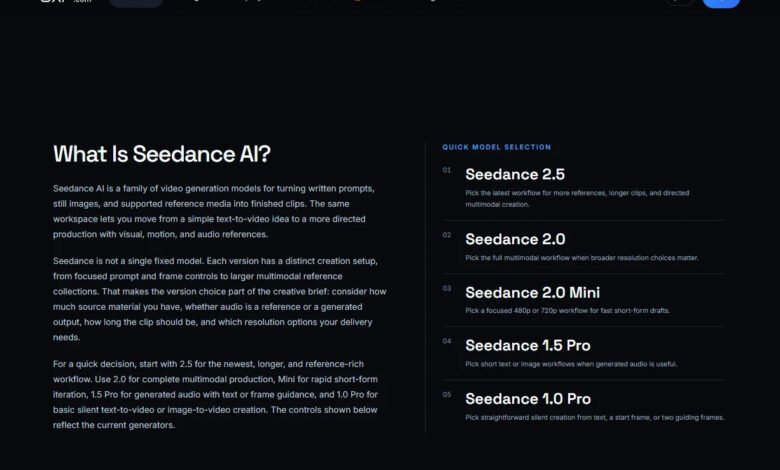
Seedance on JXP supports prompt-led creation, so the star can begin as a written scene rather than a finished illustration. Describe its rotation, a fixed viewpoint, and steady light as the intended action. Those are creative instructions to assess in the result, not a promise that the generation will close into a perfect loop.
The generator supplies a clip; the editor decides whether any section of it can repeat comfortably. Keeping those two jobs separate avoids expecting a prompt to solve a cut that has not yet been examined.
Choose the return before adding the spectacle
Some actions have a plausible route back to their starting state. A suspended ornament turns, a small flag sways, or a reflected patch of light passes over a surface. A smashed cup does not naturally reassemble itself. A drawer opening and closing may return to the same position, but it also creates a repeated event that could become tiring.
For the star, there are three possible approaches. None requires pretending that every generated result will be usable.
- Find a matching turn. Trim between two moments where the star has a similar orientation, position, and movement. Its shadow must make sense across the join too.
- Use a gentle back-and-forth movement. A small swing may be easier to repeat than a full rotation, provided the changes of direction feel natural.
- Make the restart deliberate. A brief title card or clear visual break can separate repetitions when hiding the join would demand an awkward edit.
Reversing a clip is another editing option, but it changes the action. A swinging decoration may tolerate it; drifting smoke or falling paper can suddenly appear to move backwards. Watch the whole scene, not just the central object, before choosing that shortcut.
The background can give the cut away
A star can return to its starting angle while the rest of the scene has quietly changed. A pencil may have moved, the desk grain may look different, or the camera may have crept closer. Repeating the clip makes those changes particularly obvious because the viewer sees the before and after together.
For this illustration, a plain surface and a restrained arrangement give the join fewer competing details. That is a design choice, not a requirement to make every looping video minimal. A busier scene can work, but each extra element adds another relationship to inspect.
Light deserves attention as well. A dramatic sweep may look attractive once, then produce a bright pulse every time the clip restarts. Choose that pulse intentionally or remove it from the repeating section. A crossfade can soften a small mismatch, but a long dissolve may create two translucent stars rather than one convincing movement.
Give the first image enough room to move
If the star begins as an illustration, leave space around its tips and beneath its shadow. A beautifully tight still composition may have no room for the object to swing without touching the edge of the frame.
The Seedance image workflow offers another starting point: an eligible image establishes the visual design while the prompt describes the intended movement. Available frame and reference options can differ by model, so check the controls in the selected workflow before planning around them.
Use an original, non-identifying design that is permitted by the selected workflow. An image being available online does not establish permission to upload it for AI processing. There is no need for somebody else’s illustration when a simple paper shape will answer the creative question.
Watch the third repetition, not only the first
Play the edited sequence several times without stopping it manually. A join that escapes attention once may become distracting on the third pass. Notice whether the movement remains pleasant or starts to feel like an object repeatedly demanding attention.
Then view it beside the content it will accompany. On a digital invitation, the star should leave room to read the date; beside a magazine introduction, it should not keep pulling attention away from the opening sentence. If it competes, try a smaller display or play it once instead of repeatedly rebuilding the animation.
If the clip includes sound, listen across the boundary separately. A chopped note or repeated impact can expose an otherwise quiet join. Sound can be edited independently; a visual loop does not need a musical flourish on every restart.
Sometimes the better answer is to let the video end. A short action with a clear finish may be stronger than a forced cycle. Repetition is a creative choice, not a quality badge.
The paper star does not need a bigger scene. It needs a return that belongs to the movement. When the ending leads comfortably back into the beginning, the viewer can keep looking without being reminded where the file stops.