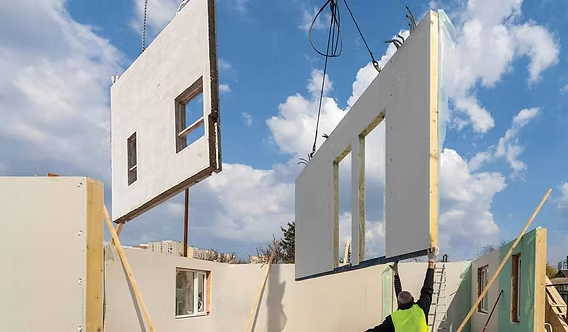
The construction industry in the United States is changing fast. More contractors and developers are turning to modular and prefab building methods to save time, cut costs, and deal with ongoing labor shortages. At the center of this shift is a material that has been around for decades — drywall. What was once thought of as a simple finishing product is now playing a much bigger role in how modern buildings come together.
The Rise of Modular and Prefab Construction
Modular and prefab construction means that large portions of a building are built in a factory or off-site facility, then transported and assembled on the job site. This approach is growing rapidly across the country — from multifamily housing and hotels to healthcare facilities and commercial offices.
The appeal is clear. Off-site construction reduces weather delays, shortens project timelines, and allows for better quality control. But for this method to work efficiently, every material involved must be precise, consistent, and easy to work with. That is exactly where drywall fits in.
Contractors who rely on accurate drywall takeoff services at the early planning stage are finding that modular projects demand even tighter quantity control than traditional builds. When panels are being cut and assembled in a factory, there is little room for over-ordering or running short mid-production.
Why Drywall Works So Well in Prefab Settings
Drywall — also called gypsum board or sheetrock — has properties that make it ideal for off-site manufacturing. It is lightweight, easy to cut, fire-resistant, and available in a wide range of thicknesses and types. These qualities translate well to a controlled factory environment where precision and speed matter.
In modular construction, wall panels are framed, insulated, and drywalled before the module ever leaves the factory. This means finishers can work in a clean, climate-controlled space without dealing with wind, rain, or the chaos of a busy job site. The result is a more consistent finish quality and faster overall project completion.
Material suppliers are seeing this demand shift firsthand. Orders for specialized drywall products — such as moisture-resistant board, abuse-resistant panels, and lightweight gypsum — are growing as more contractors adopt prefab workflows. Suppliers who stock these products and can deliver on short notice to fabrication facilities are gaining a clear advantage in the market.
The Quantity Control Challenge
One of the biggest differences between traditional and modular construction is how materials are ordered. On a conventional job site, there is usually some flexibility — you can place a quick order if you run short. In a factory setting, that is not so simple. Production schedules are tight, and delays waiting for materials can hold up an entire module assembly line.
This is why accurate quantity planning is so critical in the prefab world. Contractors and fabricators need to know exact panel counts, linear footage of trim and corner bead, and board types before production begins. Getting these numbers right the first time is not optional — it is essential.
That is where professional drywall estimating services add real value. Instead of relying on rough approximations, fabricators and GCs can get precise takeoffs that account for every wall type, ceiling condition, and opening in the design. This level of accuracy directly reduces waste, controls material costs, and keeps the production line moving.
What This Means for Contractors and Suppliers
For contractors, the shift to modular and prefab construction means rethinking how and when you plan your material needs. Drywall is no longer just something you order a few days before the finishers show up. In a prefab workflow, it needs to be specified, ordered, and on-site at the fabrication facility well before production starts.
For material suppliers, this is an opportunity. Fabrication facilities need reliable partners who understand lead times, can provide consistent product quality, and are flexible enough to support phased production schedules. Building those relationships now puts you ahead as modular construction continues to grow.
The Bigger Picture
Modular and prefab construction is not a trend that is going away. Industry analysts consistently point to it as one of the fastest-growing segments of U.S. construction, driven by housing demand, labor shortages, and the push for faster project delivery.
Drywall is not just keeping up with this shift — it is helping to drive it. Its versatility, cost-effectiveness, and ease of installation in controlled environments make it one of the most important materials in the prefab toolkit.
Contractors and suppliers who understand this and plan accordingly will be well-positioned as the industry continues to evolve.